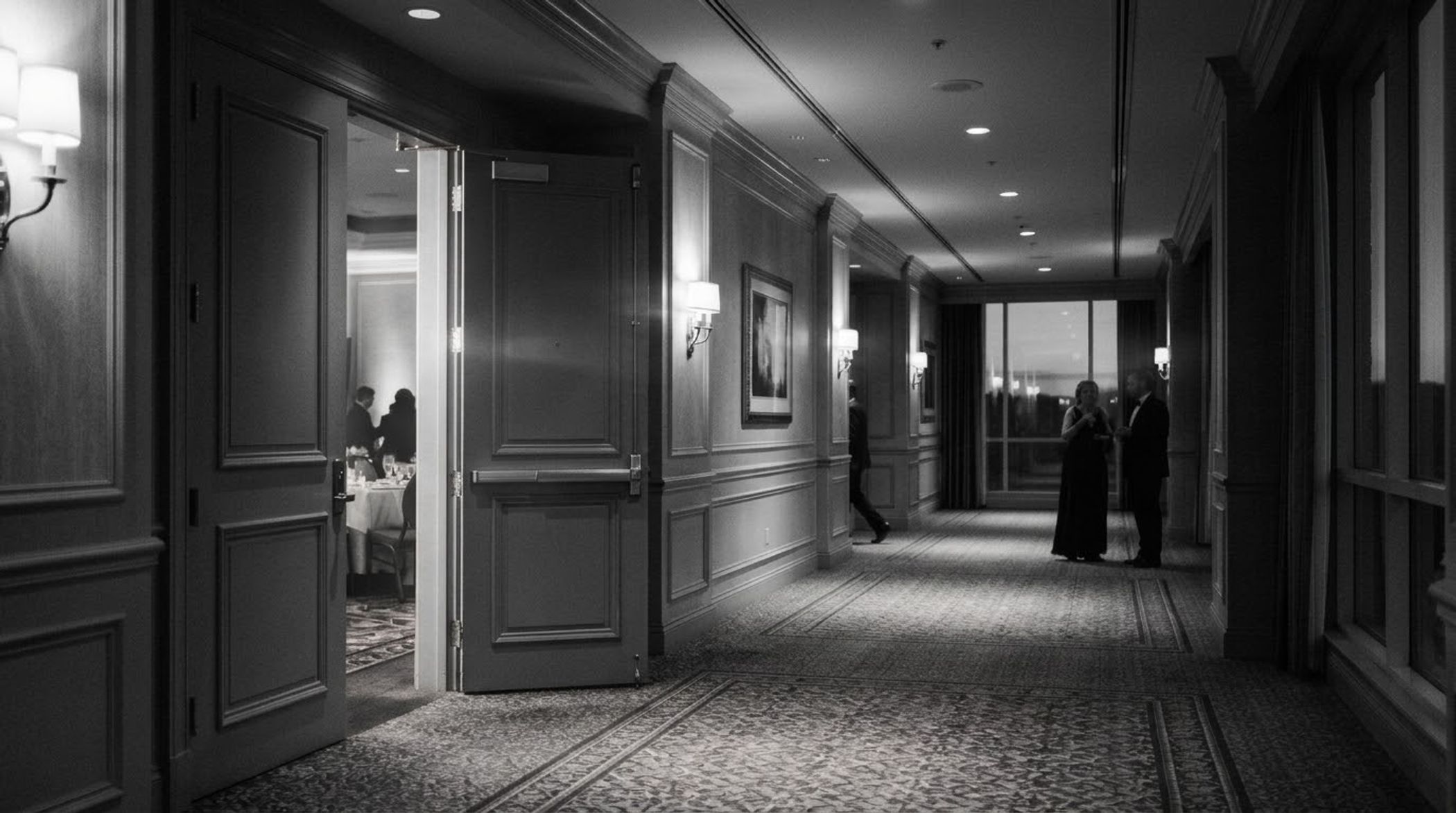
When an organization books a hotel ballroom, a resort, or a convention center for a major event, security usually gets checked off the planning list in a single sentence.
The venue provides security.
On paper, that sounds efficient. The property already has staff on site, cameras in the corridors, radios on their hips, and a line item in the facility agreement. Paying for an outside protection detail feels like buying the same thing twice.
It isn't. Venue security and event protection are two different jobs, performed for two different clients, with two different sets of priorities when something goes wrong.
Whose record gets built when something happens
That difference becomes obvious the moment an incident turns into a claim.
When something happens at a hosted event, such as an altercation, an unauthorized intrusion, or an injury during a crowd surge, plaintiffs rarely sort out the organizational chart before filing suit. They name the venue, the security contractor, and the organization that hosted the event.
At that point, the venue's risk manager, legal counsel, and insurer will do exactly what they are supposed to do. They will protect the venue.
Their incident reports, camera retention decisions, and witness statements are created through the lens of the property's liability, not yours. If your event agreement included standard indemnification or additional-insured language, as most commercial venue contracts do, you may discover after the fact that you assumed far more risk than the contract summary suggested.
Having your own protective team on site doesn't eliminate legal exposure. Nothing does. What it does is ensure that someone in the room was specifically tasked with watching your people, controlling your access points, and documenting what actually happened on your behalf.
What house security is actually hired to do
A hotel or convention center security officer has a clear, legitimate mission: protect the property, enforce house rules, manage general building incidents, and limit the venue's exposure. Every well-run facility needs that coverage.
The problem begins when an event organizer assumes that mission automatically covers their keynote speaker, their board members, their VIP guests, or their organization's reputation.
If a medical emergency happens in the lobby at the same time an uncredentialed individual is trying to reach your green room, the venue officer goes to the lobby. If a dispute breaks out at the main bar downstairs while your CEO is walking from the ballroom to a waiting vehicle, the house team handles the bar.
They are not abandoning your event. They are covering the entire building for the people who sign their paychecks.
The handover points are precisely where house coverage thins out. The loading dock, the service elevator, the valet stand, and the corridor between the ballroom and the guest elevators are the exact places where unvetted foot traffic overlaps with your principals.
What Alabama law means for the host
In Alabama, that operational split matters legally as well.
Under Alabama Supreme Court precedent, including Carroll v. Shoney's, Inc. and New Addition Club, Inc. v. Vaughn, a premises owner generally has no duty to protect someone from the criminal acts of a third party unless the particular criminal conduct was foreseeable and the owner possessed specialized knowledge of the threat. In Ex parte South Baldwin Regional Medical Center, the court reaffirmed that a facility's responsibility turns on what that specific property knew before an incident occurred.
Those cases define the venue's duty, not the event host's. For the organization hosting the event, two practical consequences follow.
First, you cannot rely on the venue's legal duty to cover risks the venue knows nothing about. The property knows its parking lot history and its lobby traffic, but it does not know which former employee or disgruntled litigant shouldn't be in your ballroom. It doesn't know which speaker drew threats last week, your executive's medical history, or which exit your driver plans to use. Without an advance, house security is reacting to strangers in a crowd.
Second, the same rule shows why coordination matters. A property can only act on what it knows. When your team briefs the venue's director of security on a specific concern, the house team can post, watch, and respond with that information in hand, instead of learning about it after something happens.
So, when is venue security enough?
Not every event needs an outside protection detail.
If you are hosting a routine daytime seminar, a local trade luncheon, or an internal training session with no high-profile principals, no public controversy, no alcohol, and no history of contentious litigation or terminations, the venue's standard coverage is usually sufficient. Paying for dedicated protection on a low-risk gathering is money you don't need to spend.
The calculation changes when specific risk factors enter the room:
- Named principals such as executives, board members, elected officials, or high-visibility speakers.
- Controversial topics or public attention that could draw protesters, media, or uninvited disruptors.
- Sensitive internal history, including recent layoffs, contentious litigation, or protective orders.
- Evening events with alcohol where social boundaries loosen and access control becomes harder.
- High-net-worth guests or attendees traveling with their own staff and vehicles.
When one or more of those factors are present, relying solely on house security leaves a gap between what the venue covers and what your organization actually needs.
How the two teams work together
Good event security doesn't replace venue security. It integrates with it.
When we run an advance for an event, one of our first conversations is with the property's director of security. We want to know how our teams will communicate during the event, any known areas with limited video coverage, their medical response procedures, and where their posts are staged. We share what we can, establish clear boundaries, and make sure we aren't duplicating effort or getting in each other's way.
The venue team keeps doing what it does best: managing the building, supporting general guest safety, and handling facility issues.
Our team focuses exclusively on the client's footprint:
- Access control at registration, VIP rooms, and backstage corridors so problems are turned away quietly before they reach a principal.
- Advance and route planning from arrival to departure, including alternate exits and vehicle staging.
- Dedicated principal coverage for executives, speakers, or guests who carry elevated visibility or risk.
- Real-time coordination with the event planner, the driver, and local emergency services if conditions change.
The question to ask before you sign
Before your next board retreat, shareholder meeting, fundraiser, or conference, look at the line in your budget that says Venue Security Included and ask one question:
If two things go wrong at the exact same time, one in the hotel lobby and one outside your ballroom door, who is coming to your door?
If you don't know the name of the person responsible for answering that call, you don't have event security. You have a building with guards in it.
If you are a planner, chief of staff, or general counsel with an event on the calendar, we are glad to talk through whether venue coverage is enough. Every engagement starts with a conversation. Reach us at praesidiumpro.com.
I am not an attorney, and nothing here is legal advice. Businesses should consult their own counsel regarding venue contracts and specific legal exposure.
Sources
- Carroll v. Shoney's, Inc., 775 So. 2d 753 (Ala. 2000)
- Ex parte South Baldwin Regional Medical Center, 785 So. 2d 368 (Ala. 2000)
- New Addition Club, Inc. v. Vaughn, 903 So. 2d 68 (Ala. 2004)