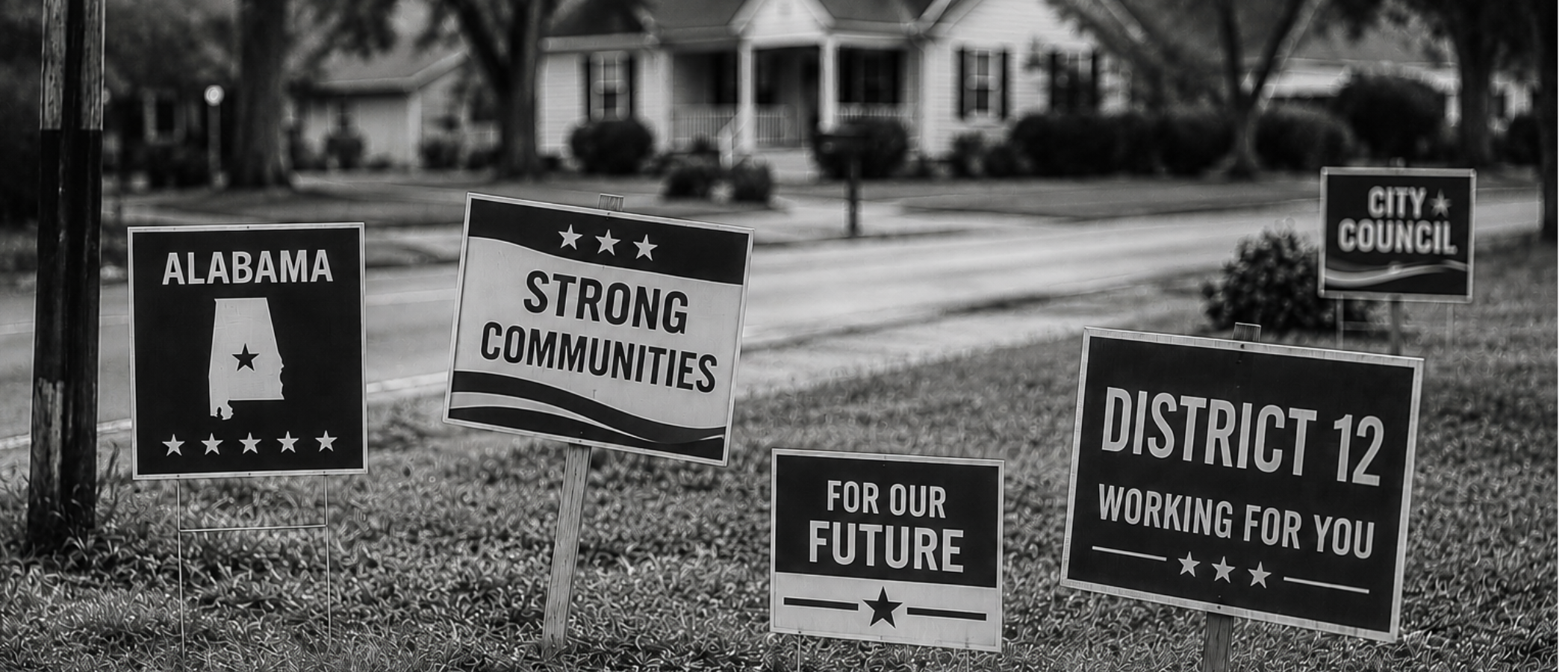
When most people picture political violence, they picture Washington. A senator, a governor, someone with a national profile and a security detail already in place. What gets missed is how little protection often exists farther down the political ladder: county commissioners, state legislators, mayors, and candidates running their first campaign out of a spare bedroom.
A recent Alabama case shows what that exposure looks like, and it came out of Baldwin County.
What was reported in Baldwin County
According to reporting by ALPolitics.com, Christina Woerner McInnis, a Baldwin County farmer and businesswoman who was then a candidate for Alabama Commissioner of Agriculture and Industries, was the target of a months-long harassment campaign. The same reporting states that the man responsible created more than two dozen fake online profiles used to harass and threaten McInnis, her children, and other women over roughly six months, and that he later pled guilty to stalking and harassment charges. Coverage of the case indicates the Baldwin County Sheriff’s Office, Orange Beach Police Department, and the FBI were all involved, and that a restraining order was issued.
ALPolitics also reported that Rep. Donna Givens, R-Loxley, cited the case when she pre-filed legislation ahead of the 2026 session to increase penalties for harassing or threatening public officials. Separately, CBS 42 reported in November 2025 on Givens’ effort, with Rep. Patrick Sellers, D-Birmingham, voicing support on the grounds that clearer protections might make more people willing to serve.
What local officials are reporting
National survey data points the same direction. The Bridging Divides Initiative at Princeton University, working with CivicPulse, surveyed more than 460 local elected officials in the first quarter of 2026. Fifty-four percent reported experiencing at least one form of hostility during the survey period. Seventy-six percent said they had become less willing to engage in at least one political or civic activity, including running for reelection, because of concerns about hostility. BDI describes that second figure as the highest total rate its survey has recorded since it began in 2022.
The officials in that data are mayors, council members, county commissioners, and school board members. Not senators.
What Alabama did, and what it didn’t
The Legislature took up this problem from two directions in the 2026 regular session. Only one of them made it into law.
On the funding side, SB230, sponsored by Sen. Sam Givhan, R-Huntsville, amended the state’s Fair Campaign Practices Act to authorize campaign funds for security expenses protecting a candidate, an elected official, or their immediate family or staff. Reporting on the bill describes three covered categories: cybersecurity services, including removal of personal information from data brokers and online sources; nonstructural security devices such as alarms, locks, cameras, and monitoring systems; and security personnel. It passed both chambers unanimously and was signed in late February 2026, taking effect immediately. The Vote Mama Foundation, which tracks these policies nationally, counts Alabama as the twenty-second state to authorize campaign funds for security.
On the penalty side, lawmakers made a serious attempt that fell short. Two bills addressing this conduct moved during the session. HB106, carried by Rep. Givens, would have expanded Alabama’s doxing statute and raised penalties for repeat offenses; it cleared the House 105-0 in March and then stalled in Senate Judiciary. HB293, carried by Rep. Juandalyn Givan, D-Birmingham, would have elevated harassment and harassing communications to a Class B misdemeanor when the victim is a public official; it never reached a floor vote. Both died when the session adjourned on April 9, and neither is law today.
The bills drew bipartisan support, but neither penalty measure became law. The Legislature authorized security spending but did not increase the penalties addressed by HB106 or HB293. For many local officials and candidates, that leaves a substantial part of the protective burden with them, before something happens.
What this means in practice
If you are a local official, a candidate, or you advise one, a few questions are worth answering before they become urgent:
- Does the campaign have a plan for handling a credible threat, not just a policy for reporting one?
- Has anyone looked at what is publicly findable about the candidate and their family online?
- Beyond filing a police report, is there a plan for the family's day-to-day safety while that plays out?
None of this requires treating a county commissioner like a head of state, and it shouldn’t. Most of what actually reduces risk at this level is unglamorous and proportionate.
Sometimes it is a conversation and an assessment: what is findable about you online, what your routine looks like from the outside, where your home and office are exposed, and what you and your staff should do if something arrives in the mail or shows up at a door. That work is frequently the entire engagement.
Sometimes it is narrower than that. A single town hall, a parade, a debate, a ribbon cutting. Open events with an announced time and place create a predictable point of exposure, and covering one well is very different from retaining a standing detail.
Occasionally it is a detail, when the threat picture genuinely calls for it. That is the smallest category, not the default.
Two of those categories map directly onto what SB230 names: cybersecurity services and security personnel. Whether any particular engagement qualifies as a permissible campaign expense is a question for your campaign’s compliance counsel and the Secretary of State’s guidance, not something to take from an article. What is settled is that the Legislature passed the bill without a dissenting vote.
Praesidium Protective Services is licensed statewide and based in Baldwin County. We work with individuals and organizations to assess these risks and, when circumstances warrant it, provide protective coverage for specific events or ongoing concerns.
Sources
"Christina Woerner McInnis Responds Following Guilty Plea in Baldwin County Stalking Case," ALPolitics.com.
"State Rep. Donna Givens Pre-Files Bill to Increase Penalties for Harassing or Threatening Public Officials," ALPolitics.com.
"Bill would increase penalties for harassing officials in Alabama," CBS 42, November 2025.
"House passes bill to increase doxing penalties, change definition," Alabama Daily News, March 2026.
Alabama HB106, 2026 Regular Session, LegiScan (status: died in Senate Judiciary).
Alabama HB293, 2026 Regular Session, BillTrack50 (status: dead, April 9, 2026).
"Legislature passes bills to allow campaign funds to be spent on personal security," Alabama Gazette, March 2026.
"Bills signed by Gov. Ivey so far during the 2026 legislative session," WSFA, March 2026.
"Survey Briefing: Threats and Harassment Against Local Officials in 2026," Princeton University Bridging Divides Initiative.